

Hand paying cash with dollar bills and car keys on one side versus person reviewing auto loan paperwork on the other side
Buying a Car with Cash vs Loan: Which Option Makes Financial Sense?

The decision between writing a check for your next vehicle or spreading payments over several years isn't just about whether you have the money. A buyer with $35,000 in savings faces a genuine strategic choice: deploy that capital now or keep it working elsewhere while making monthly payments. Each path carries distinct financial consequences that extend far beyond the showroom.
Most personal finance advice defaults to "avoid debt whenever possible," but this blanket rule ignores the nuances of low-interest borrowing in an environment where your money might earn more invested than a loan costs. At the same time, financing advocates often underestimate the psychological weight of monthly obligations and the risk of overextending.
The right answer depends on your specific financial position, the terms available to you, and what else you could do with that money. This analysis breaks down the math, psychology, and strategy behind both approaches.
How Cash and Financed Car Purchases Impact Your Financial Health
Paying cash creates an immediate, substantial reduction in liquid assets. A buyer who spends $30,000 from savings sees their emergency cushion or investment portfolio shrink by that exact amount the moment they sign the title. The car is yours completely, but that capital is now locked into a depreciating asset that loses roughly 20% of its value in the first year alone.
Financing preserves liquidity. That same $30,000 remains in your bank account or brokerage, available for emergencies, investment opportunities, or other priorities. Instead, you commit to a monthly obligation—perhaps $450 to $550 depending on terms—that continues regardless of income changes, medical emergencies, or other financial surprises.
The cash flow strategy differs fundamentally between approaches. Cash buyers eliminate a recurring expense before it starts, reducing their monthly overhead permanently. Their budget has more flexibility going forward because they've eliminated one potential obligation. Financed buyers maintain higher liquid reserves but accept reduced monthly cash flow for the loan duration. If you're currently spending $2,800 monthly and earning $5,000, a $500 car payment reduces your monthly surplus by nearly 23%.
Neither approach is inherently superior—the liquidity vs financing comparison hinges on your broader financial picture. Someone with $80,000 in savings and stable income faces different trade-offs than someone with $35,000 saved and variable commission-based earnings.

Author: Lena Prescott;
Source: shafer-motorsports.com
The True Cost of Auto Financing: Interest Rates and Total Payment Breakdown
Auto loan rates vary considerably based on credit score, loan term, vehicle age, and lender. As of 2024, buyers with excellent credit (720+) typically qualify for new car rates between 5.5% and 7.5%, while used car loans run 6.5% to 9.5%. Buyers with good credit (680-719) might see rates 1-2 percentage points higher. Below 680, rates can exceed 12% or more.
Loan term selection dramatically affects total interest paid. Extending from 48 to 72 months reduces monthly payments but increases total cost substantially. A $30,000 loan at 7% APR costs $2,280 in interest over 36 months but $4,661 over 72 months—more than double despite the same principal and rate.
Here's how different scenarios compare for a $30,000 vehicle purchase:
| Loan Term | Interest Rate | Monthly Payment | Total Interest Paid | Total Amount Paid |
| Cash | 0% | $0 | $0 | $30,000 |
| 36 months | 4% | $885 | $1,867 | $31,867 |
| 36 months | 7% | $926 | $3,343 | $33,343 |
| 36 months | 10% | $968 | $4,841 | $34,841 |
| 48 months | 4% | $677 | $2,505 | $32,505 |
| 48 months | 7% | $718 | $4,470 | $34,470 |
| 48 months | 10% | $761 | $6,516 | $36,516 |
| 60 months | 4% | $552 | $3,150 | $33,150 |
| 60 months | 7% | $594 | $5,642 | $35,642 |
| 60 months | 10% | $637 | $8,251 | $38,251 |
| 72 months | 4% | $469 | $3,802 | $33,802 |
| 72 months | 7% | $506 | $6,824 | $36,824 |
| 72 months | 10% | $544 | $9,145 | $39,145 |
The interest cost comparison reveals why buying a car with cash vs loan isn't a simple calculation. At 4% over 36 months, you're paying $1,867 for the privilege of keeping $30,000 liquid. At 10% over 72 months, that privilege costs $9,145—nearly one-third of the vehicle's value.
Opportunity Cost: What You Give Up When Paying Cash
The opportunity cost car purchase calculation asks: what else could that $30,000 do if you didn't spend it on a vehicle?
If you invested $30,000 in a diversified portfolio averaging 8% annual returns over five years, you'd have approximately $44,080 before taxes. Even a conservative portfolio averaging 5% would grow to roughly $38,290. Meanwhile, financing that same car at 6% over 60 months costs about $4,800 in interest. The net difference between investing the cash and paying loan interest represents your true opportunity cost.
Conservative scenario (5% investment return vs 6% loan): - Investment growth: $8,290 - Loan interest cost: $4,800 - Net advantage to financing: $3,490
Moderate scenario (8% investment return vs 6% loan): - Investment growth: $14,080 - Loan interest cost: $4,800 - Net advantage to financing: $9,280
Aggressive scenario (10% investment return vs 6% loan): - Investment growth: $16,290 - Loan interest cost: $4,800 - Net advantage to financing: $11,490
This investment alternative analysis assumes you actually invest the difference rather than spending it. Many people who finance with the intention of investing the cash equivalent never follow through. The $30,000 sits in checking earning 0.5%, or gradually gets spent on other purchases. In that case, the opportunity cost calculation collapses—you're paying interest without gaining the investment returns that justify financing.
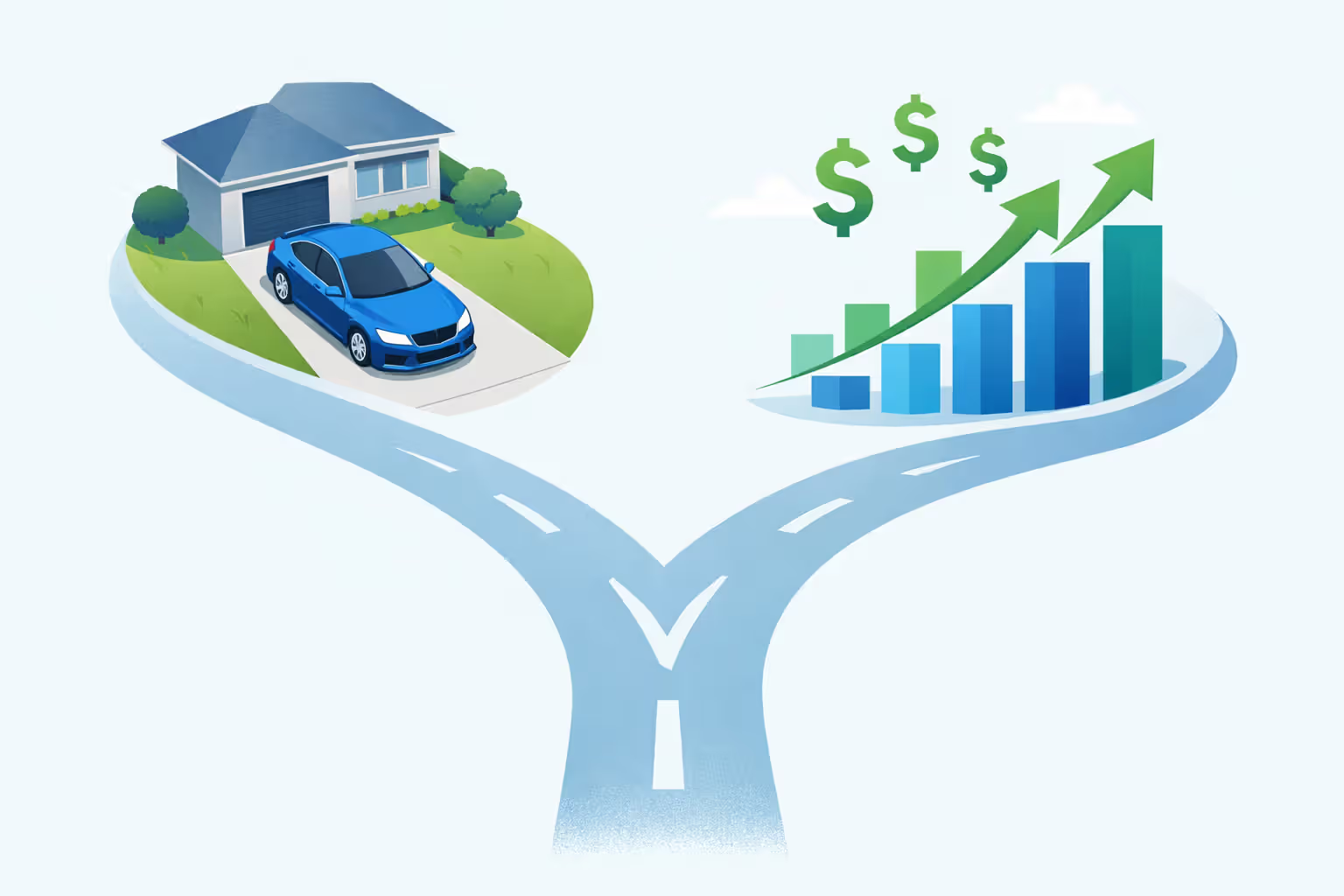
Car depreciation complicates this further. Your vehicle drops from $30,000 to roughly $24,000 in year one regardless of payment method. But if you financed and invested the cash, you've potentially grown your investment by $2,400 (at 8%) while the car depreciated by $6,000. Your net worth is higher than if you'd paid cash and watched the same $6,000 evaporate from your asset column with no offsetting investment growth.
Author: Lena Prescott;
Source: shafer-motorsports.com
When Paying Cash Actually Saves You Money
Despite opportunity cost arguments favoring financing under certain conditions, cash purchases offer concrete advantages in specific situations.
Avoiding interest charges eliminates the most obvious cost. Even at modest rates, you're paying thousands for the convenience of spreading payments. A buyer who pays $33,600 total on a 60-month loan at 6% spends $3,600 more than the cash buyer for the identical vehicle. That's $3,600 that could fund Roth IRA contributions, build emergency savings, or cover insurance and maintenance.
Some dealers offer cash discounts, though this has become less common as dealerships earn substantial income from financing arrangements. However, private party sellers almost always prefer cash, and you'll have stronger negotiating leverage when you can close immediately without financing contingencies. The ability to say "I'll write you a check today for $27,500" carries weight that "I need to get loan approval" doesn't.
Psychological benefits matter more than spreadsheets suggest. Debt-free ownership means no repossession risk, no monthly obligation hanging over your budget, and the freedom to drive the vehicle into the ground without worrying about owing money on a worthless asset. Some buyers sleep better knowing they own their car outright, and that peace of mind has value even if it doesn't appear in opportunity cost calculations.
Insurance costs sometimes differ between financed and cash purchases. Lenders require comprehensive and collision coverage, while cash buyers can legally drop these coverages (though this is rarely wise for newer vehicles). For older cars worth $5,000 or less, cash buyers might reasonably carry only liability coverage, saving $500-800 annually compared to full coverage.
Financial planning for vehicle purchase becomes simpler without loan obligations. Your monthly budget has one less required expense, giving you more flexibility to handle income fluctuations, save for other goals, or weather unexpected costs.
Too many people buy things they don’t need with money they don’t have to impress people they don’t like. The real cost of a thing is the amount of life you exchange for it
— Henry David Thoreau
When Financing Makes More Financial Sense
Low promotional rates flip the entire calculation. Manufacturers occasionally offer 0%, 0.9%, or 1.9% APR financing as sales incentives. At these rates, you're essentially borrowing for free or near-free after accounting for inflation. Someone who finances $30,000 at 0.9% over 60 months pays only $678 in interest while keeping $30,000 invested. Even conservative investment returns exceed that minimal cost.
Preserving emergency funds represents perhaps the strongest argument for financing. Financial advisors typically recommend 3-6 months of expenses in liquid savings before making major purchases. If you earn $5,000 monthly and have $35,000 saved, spending $30,000 on a car drops your emergency fund from seven months to one month. A job loss, medical emergency, or major home repair could force you into high-interest credit card debt—a far worse outcome than a manageable auto loan.
Credit score building through auto loans benefits buyers with limited credit history. Payment history comprises 35% of your FICO score, and installment loans (like auto financing) add diversity to your credit mix. Someone with only credit cards might strategically choose financing to strengthen their credit profile, particularly if planning to apply for a mortgage within a few years. However, this benefit only applies if you make every payment on time—late payments devastate your score.
Inflation works in your favor with fixed-rate loans. A $500 monthly payment in 2024 represents less real cost in 2028 after four years of wage growth and currency devaluation. You're repaying the loan with cheaper future dollars while the $30,000 you kept invested maintains purchasing power through growth. At 3% annual inflation, your final loan payments feel roughly 15% less burdensome than the initial ones.
The liquidity vs financing comparison favors financing when you have productive uses for capital. Business owners might earn 15-20% returns reinvesting in their companies. Real estate investors might leverage that $30,000 into a down payment on rental property generating monthly cash flow. Even paying off credit card debt at 22% APR represents a better use of $30,000 than avoiding a 6% car loan.

Author: Lena Prescott;
Source: shafer-motorsports.com
5 Critical Mistakes People Make When Choosing Between Cash and Financing
Depleting Emergency Savings to Avoid a Loan
The most common error is prioritizing debt avoidance over financial security. A buyer with $32,000 saved who spends $30,000 on a car has only $2,000 remaining—perhaps three weeks of expenses. The first unexpected cost forces them onto credit cards at 20%+ APR, a far worse situation than a 7% auto loan would have been.
Emergency funds exist for emergencies, and cars can be financed. Unless you have substantial additional savings beyond what you're spending, keeping 3-6 months of expenses liquid should take priority over avoiding a reasonable auto loan.
Ignoring Manufacturer Incentives That Require Financing
Dealers often structure promotions as either cash rebates or low APR financing, but not both. A typical offer might be "$3,000 cash back or 1.9% APR for 60 months." Some buyers automatically take the rebate, assuming cash is always better, without running the numbers.
On a $30,000 purchase, the $3,000 rebate reduces your price to $27,000 if paying cash. But if you financed $30,000 at 1.9% over 60 months, you'd pay only $1,484 in interest—saving $1,516 compared to taking the rebate and paying cash. You'd also keep $27,000 invested. Always calculate both scenarios before deciding.
Overlooking the Investment Opportunity Cost
Many buyers compare loan interest rates to savings account rates (0.5% - 1%) rather than realistic investment returns (6% - 10% historically). They think, "My savings earn 0.5%, but the loan costs 6%, so I'm losing 5.5% by financing." This misses the point entirely.
The relevant comparison is what you could earn by investing that money in a diversified portfolio, not what it earns sitting in a savings account. If your investment alternative analysis shows potential 8% returns against a 6% loan, financing makes mathematical sense—assuming you actually invest the difference.
Choosing Long Loan Terms to Lower Monthly Payments
Stretching to 72 or 84 months to afford a more expensive car creates multiple problems. You'll be underwater (owing more than the car's worth) for years, pay substantially more interest, and likely still be making payments when the vehicle needs major repairs or replacement.
A useful rule: if you need more than 60 months to afford the payment, you're buying too much car. The lower monthly payment doesn't make the vehicle more affordable—it just disguises the fact that it's beyond your budget.
It is not the man who has too little, but the man who craves more, that is poor. Wealth consists not in having great possessions, but in having few wants — and in making every financial decision with clarity, not fear
— Seneca, Letters from a Stoic
Failing to Compare Total Cost of Ownership
Buyers often focus exclusively on purchase price and financing costs while ignoring insurance, fuel, maintenance, and depreciation differences between options. A luxury vehicle might be available at an attractive 2.9% APR, but if it costs $400 more monthly for insurance and premium fuel compared to a practical alternative, the financing rate is irrelevant.
Financial planning for vehicle purchase requires analyzing the complete five-year cost picture, not just the sticker price and interest rate.
Author: Lena Prescott;
Source: shafer-motorsports.com
How to Decide: A Step-by-Step Framework for Your Situation
Start by assessing your emergency fund status. Calculate your essential monthly expenses (housing, food, utilities, insurance, minimum debt payments). Multiply by three for a minimum emergency fund, or by six for a comfortable cushion. If paying cash would drop you below this threshold, financing deserves serious consideration regardless of other factors.
Calculate your true opportunity cost by comparing realistic investment returns against available loan rates. If you can borrow at 5% but historically earn 8% in your investment portfolio, the 3% spread favors financing. If you can't honestly commit to investing the cash equivalent, or if available rates exceed 9-10%, the opportunity cost argument weakens considerably.
Evaluate current loan offers from multiple sources. Check your bank or credit union first—they often beat dealer rates by 0.5-1%. Get pre-approved before shopping so you know your real options. If you qualify for promotional rates below 3%, financing becomes much more attractive. Above 8%, cash or a larger down payment makes more sense unless your emergency fund is thin.
Consider your broader financial situation. Are you carrying high-interest debt? Building toward a home down payment? Facing income uncertainty? These factors might outweigh the pure math of interest rates versus investment returns.
According to Certified Financial Planner Michael Chen of Pathway Financial Planning: "The cash versus financing decision isn't about following a universal rule—it's about understanding your complete financial picture. I've seen clients make the right choice by financing at 6% because they needed liquidity for their business, and others make the right choice by paying cash despite 2% financing because eliminating the monthly obligation reduced their stress substantially. The numbers matter, but so does your specific situation and what helps you sleep at night."
A practical decision tree looks like this:
Is your emergency fund below 3 months of expenses? → Finance the car and preserve cash reserves.
Do you have 6+ months of expenses saved beyond the purchase price? → Consider the opportunity cost calculation.
Can you borrow below 4%? → Financing likely makes mathematical sense if you invest the difference.
Is the rate above 8%? → Pay cash unless it depletes emergency savings.
Between 4-8%? → Compare specific investment returns versus loan costs, and consider psychological factors.
Frequently Asked Questions About Cash vs Financed Car Purchases
Making Your Decision With Confidence
The choice between buying a car with cash vs loan isn't about following dogmatic rules—it's about understanding how each option affects your specific financial situation. Cash purchases eliminate interest costs and monthly obligations but tie up capital in a depreciating asset. Financing preserves liquidity and potentially allows investment growth but adds interest costs and monthly commitments.
Run the numbers for your situation. Calculate whether you'll maintain adequate emergency savings after a cash purchase. Compare available loan rates against realistic investment returns. Consider psychological factors like your comfort with debt and the value you place on financial flexibility.
Most importantly, avoid the extremes. Don't deplete savings to avoid a reasonable loan, but don't finance unnecessarily at high rates when you have ample cash reserves. The right answer lies somewhere in the middle, shaped by your income stability, savings level, available rates, and broader financial goals.
Your car purchase represents one decision within a larger financial life. Make it thoughtfully, considering both the immediate impact and long-term consequences, and you'll drive away confident you made the right choice for your circumstances.
Related Stories
Read more
Read more

The content on Auto Insights is provided for general informational and educational purposes only. It is intended to offer guidance on car buying, vehicle ownership, finance, insurance, EVs, maintenance, accessories, reviews, and related topics, and should not be considered professional financial, legal, insurance, mechanical, or investment advice.
All information, tools, calculators, comparisons, and recommendations presented on this website are for general guidance only. Individual financial situations, driving habits, vehicle conditions, insurance policies, and market factors vary, and actual results or costs may differ from estimates provided.
Auto Insights makes no guarantees regarding accuracy, completeness, or current applicability of the information, as automotive markets, regulations, incentives, interest rates, and vehicle specifications may change over time.