
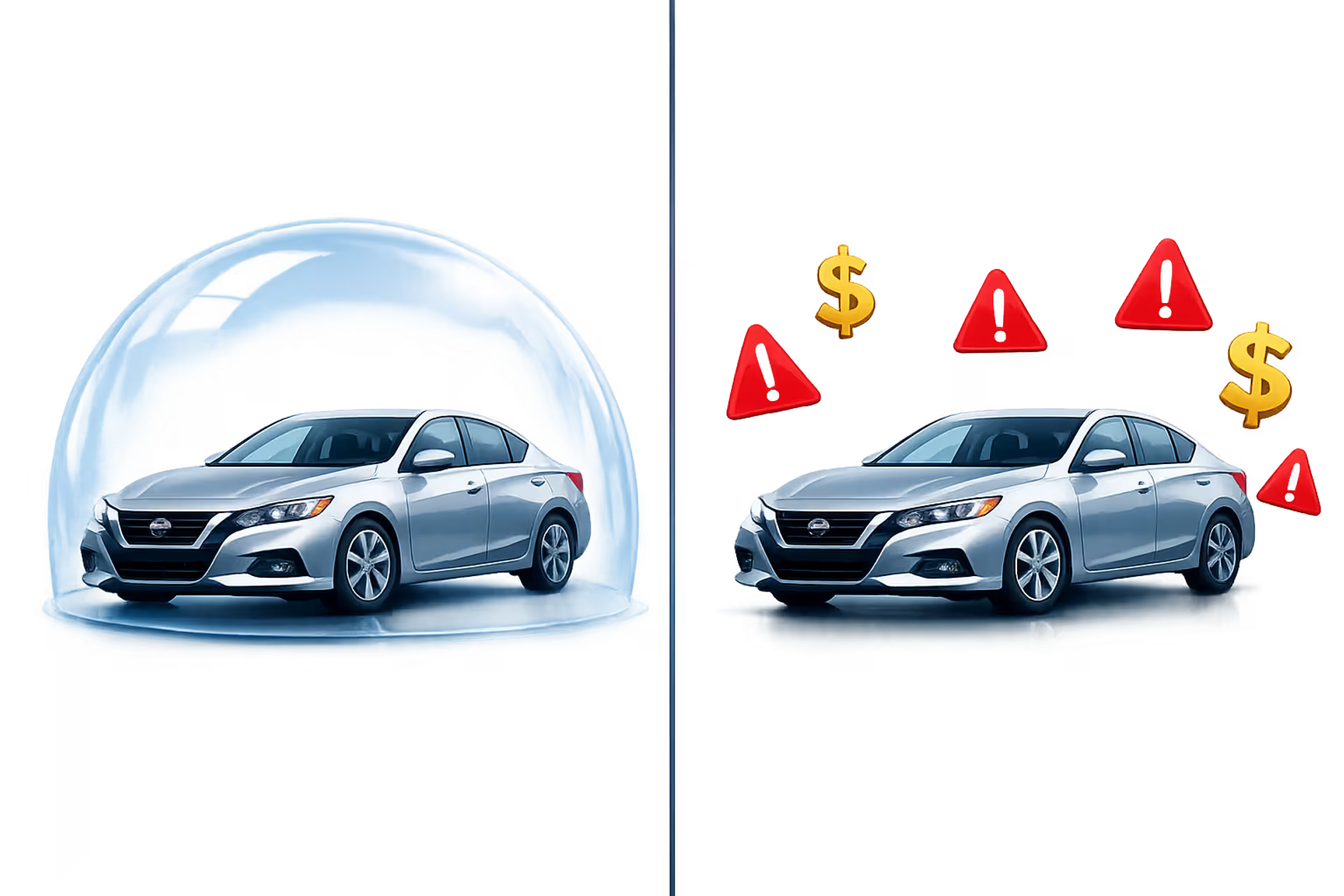
Car with and without insurance protection shield comparing covered versus unprotected vehicle
Car Insurance Coverage Types: What Each Policy Protects and Costs

Shopping for auto insurance? You'll encounter liability limits written as 25/50/25, terms like "comprehensive" that don't actually cover everything, and sales pitches for "full coverage" that isn't really full. Each coverage piece protects different parts of your financial life.
Here's what matters: the difference between paying $75 monthly for basic liability versus $200 for a comprehensive package isn't just about price. It's about who pays when things go wrong. I've seen drivers lose their homes after causing accidents with inadequate liability limits. I've also watched people spend $1,800 yearly protecting a car worth $3,000.
Let's break down what you're actually buying, how these coverages work in real situations, and which combinations make sense for your specific situation.
State-Required vs. Optional Coverage: What You Must Buy
Drive legally in any state except New Hampshire, and you'll need liability insurance. Period. States created these requirements after too many accident victims got stuck with bills when at-fault drivers couldn't pay.
Here's what liability does: pays for damage you cause to others. Their medical bills? Covered. Their car repairs? Covered. Your own hospital stay or vehicle repairs? Not covered at all. That's where optional coverages come in.
States take different approaches to insurance requirements. Some follow traditional tort systems—you cause the accident, your insurance pays everyone's bills. Others use no-fault systems where each driver's insurance covers their own medical expenses, regardless of who caused the crash. A handful of states require uninsured motorist protection. Florida and Michigan make you buy personal injury protection whether you want it or not.
Minimums vary wildly by state:
| State | Per-Person Injury Cap | Per-Accident Injury Cap | Property Damage Cap | What Else You Must Buy |
| California | $15,000 | $30,000 | $5,000 | Nothing additional |
| Texas | $30,000 | $60,000 | $25,000 | Nothing additional |
| Florida | Not required* | Not required* | $10,000 | $10,000 PIP required |
| New York | $25,000 | $50,000 | $10,000 | $25,000 UM, $50,000 PIP |
| Pennsylvania | $15,000 | $30,000 | $5,000 | $5,000 medical coverage |
| Illinois | $25,000 | $50,000 | $20,000 | $25,000 UM recommended |
| Ohio | $25,000 | $50,000 | $25,000 | Nothing additional |
| Georgia | $25,000 | $50,000 | $25,000 | Nothing additional |
| Michigan | $50,000 | $100,000 | $10,000 | Unlimited PIP (can opt out now) |
| Washington | $25,000 | $50,000 | $10,000 | Nothing additional |
*Florida requires bodily injury liability only after certain violations.
These state minimums? Often laughably inadequate. A single night in a trauma unit can exceed $25,000. Newer vehicles cost $35,000 to $50,000. Hit one at highway speed with just $25,000 property damage coverage, and you're personally liable for the difference. Trial lawyers can come after your house, retirement accounts, and wages.
Optional coverages protect your own vehicle and fill liability gaps. Collision fixes your car after crashes. Comprehensive handles everything else—theft, hail, hitting deer. Uninsured motorist coverage kicks in when someone without insurance hits you. Medical payments coverage handles your own medical bills.
Most drivers need some mix of optional coverages. Which ones depend on your car's value, your savings account balance, and how much financial risk you can stomach.
Liability Coverage Breakdown: Bodily Injury and Property Damage
Liability splits into two buckets: bodily injury and property damage. When you see coverage listed as 25/50/25, that translates to $25,000 maximum per injured person, $50,000 maximum total per accident, and $25,000 for property damage per incident.
Bodily injury liability pays when you hurt someone in a crash. Emergency room visits, surgeries, physical therapy, lost wages while they recover, pain and suffering settlements—it all comes from here. Your insurance company also covers legal defense costs up to policy limits.
The per-person cap limits what insurers pay each injured individual. The per-accident cap limits what they'll pay everyone combined in a single crash. Say you carry 25/50 limits and injure three people who each need $30,000 in medical care. Your insurer pays $50,000 total, leaving you on the hook for $40,000.
Property damage liability covers other people's vehicle repairs, buildings or fences you crash into, and equipment damaged in commercial vehicles you hit. Your own car? Not covered. That $25,000 property limit sounds reasonable until you total a $60,000 Tesla or crash into a storefront causing $80,000 in reconstruction costs.
What liability won't cover: intentional damage, crashes while using your car for commercial purposes without proper coverage, or accidents when you're driving someone else's vehicle without permission.
When Liability Alone Isn't Enough
State-minimum liability satisfies cops and DMV clerks, but it creates massive financial vulnerability. Own a home? Have retirement savings? Decent income? Minimum coverage exposes all of it to lawsuits.
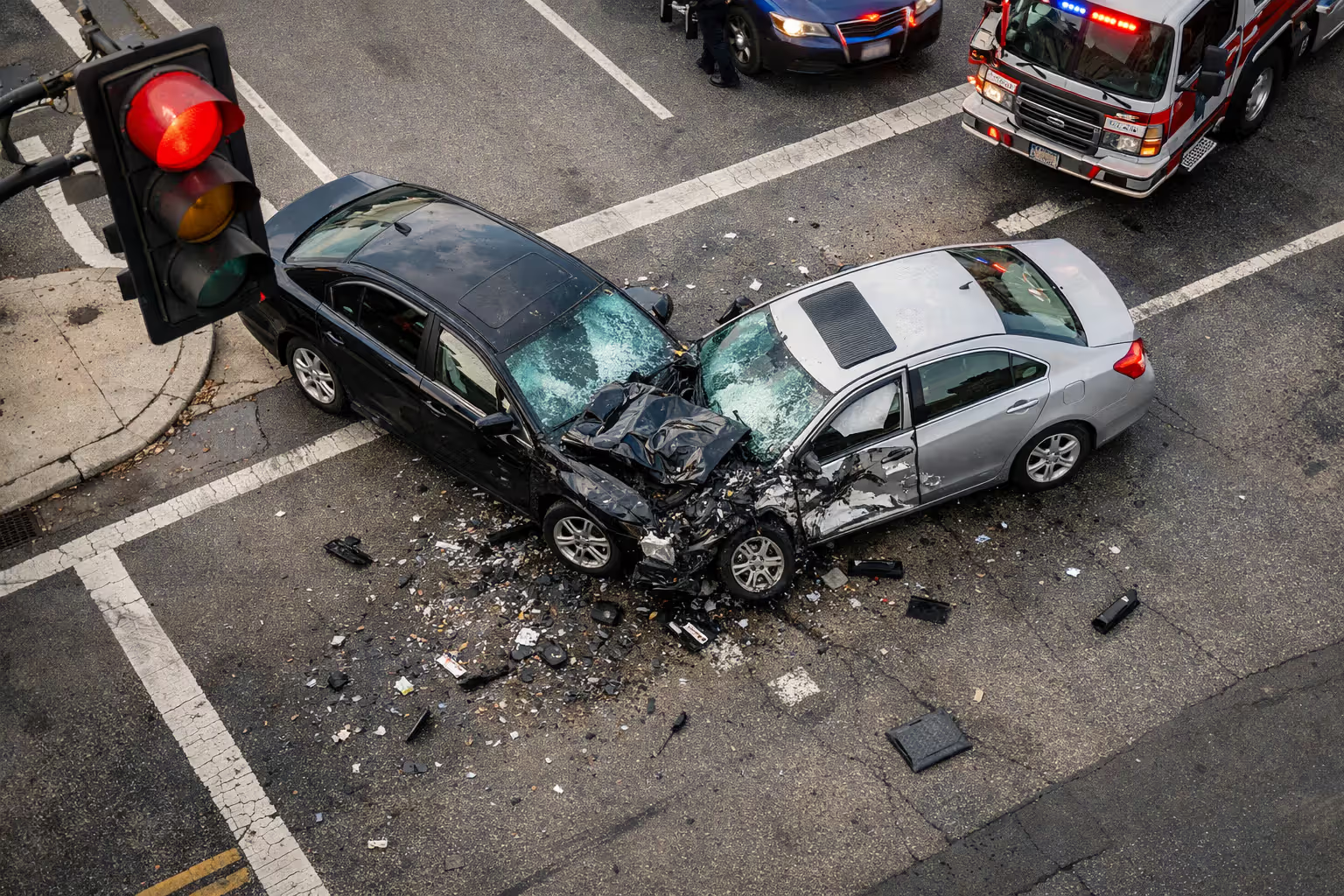
Picture this: You're texting, run a red light, T-bone another car. The driver suffers a traumatic brain injury requiring $250,000 in immediate care plus ongoing therapy. You carry California's 15/30 minimum. Your insurer writes a $15,000 check and closes your file. The victim's attorney sues you personally for the remaining $235,000. Without adequate liability protection, you could lose your house.
Most insurance advisors recommend 100/300/100 minimum liability for anyone with moderate assets. High net worth? Go higher or add umbrella coverage.
Author: Derek Fulton;
Source: shafer-motorsports.com
Umbrella Policies: Extended Liability Protection
Umbrella policies stack extra liability protection on top of your auto and home insurance. Carry 250/500 auto liability plus a $1 million umbrella? You've got $1.25 million total protection.
Umbrella coverage costs surprisingly little—usually $150 to $300 annually for $1 million in protection—because it only pays after your underlying policies exhaust their limits. These policies also cover liability situations your auto policy doesn't touch: defamation lawsuits, slander claims, wrongful arrest allegations.
You'll need elevated underlying limits to qualify for umbrella policies, typically 250/500/100 or higher on your auto insurance.
Insurance is the only product that both the seller and buyer hope is never actually used
— Warren Buffett
Collision Insurance: How It Works and Who Needs It
Collision coverage repairs or replaces your vehicle after accidents, period. Doesn't matter who's at fault. Rear-end someone? Scrape a guardrail? Roll your car on black ice? Collision pays for your repairs.
You'll pay your deductible first—commonly $500 or $1,000—then your insurer covers the rest up to your vehicle's actual cash value. Repairs cost $4,200 with a $500 deductible? You pay $500, insurance pays $3,700.
Actual cash value means what your car was worth before the accident, accounting for depreciation. Your 2015 sedan with 90,000 miles is worth $8,000, but repairs would cost $9,500? Insurer declares it totaled, cuts you a check for $8,000 minus your deductible. You don't get $9,500 for repairs or enough to buy a brand-new replacement.
Collision makes sense when your vehicle has substantial value. Rule of thumb: if your car's worth exceeds ten times your annual collision premium, coverage provides reasonable value. A $15,000 vehicle? Spending $600 yearly for collision protection makes sense. A $3,000 vehicle with that same $600 premium means you'd need to total the car within five years just to break even—unlikely if you're a careful driver.
Deductible choices directly impact premiums. Bump your deductible from $500 to $1,000? You'll typically save 15 to 30 percent on collision premiums. With $2,000 in emergency savings, higher deductibles generate long-term savings because you're self-insuring minor fender-benders.
Common mistake: keeping collision coverage on aging vehicles out of habit. Once your car's value drops below $4,000, annual premiums plus deductibles often approach maximum payouts. At that point, drop collision and bank the premium savings toward your next vehicle purchase.
Lenders and leasing companies require collision protection for financed vehicles. After paying off the loan? The choice becomes yours.
Comprehensive Coverage: Protection Beyond Accidents
Comprehensive coverage handles vehicle damage from everything except collisions. Theft, vandalism, fire, floods, hail, falling tree branches, deer strikes—comprehensive pays for repairs.
Like collision, comprehensive requires deductibles. Many drivers choose lower comprehensive deductibles ($250 or $500) than their collision deductibles because comprehensive claims often involve smaller amounts and less predictability. You can avoid causing accidents through careful driving, but you can't dodge a deer that jumps into your lane on a dark country road.
Glass damage typically falls under comprehensive. Some insurers offer $0 glass deductibles as add-ons, which helps frequent highway drivers where rock chips happen regularly. Windshield replacement costs $300 to $500 for most vehicles, and tiny chips often spread into full cracks requiring complete replacement.
Comprehensive pays actual cash value, same as collision. Flooding totals your car? You get pre-flood vehicle value, not what you paid originally or current replacement cost.
Weather-related claims happen more often than most drivers expect. Texas and Colorado hailstorms cause billions in vehicle damage annually. California wildfires destroy thousands of parked cars. Comprehensive becomes essential in severe-weather zones.
Same value calculation applies: when vehicle worth drops relative to comprehensive premiums, consider dropping coverage. However, comprehensive typically costs less than collision—often $150 to $400 yearly—so the math favors keeping comprehensive longer.

Author: Derek Fulton;
Source: shafer-motorsports.com
Full Coverage Explained: Liability + Collision + Comprehensive
"Full coverage" isn't an actual policy type—it's insurance-industry slang. When people say they have full coverage, they usually mean they carry liability, collision, and comprehensive together. This trio protects other people (liability), your vehicle after crashes (collision), and your car from non-collision damage (comprehensive).
Here's the problem with calling it "full coverage"—it's not actually full. You're not covered for mechanical breakdowns, normal wear and tear, aftermarket stereo systems you installed, or damage from street racing. It doesn't cover medical bills in many states, and rental car reimbursement requires separate addition.
Lenders require this combination on financed and leased vehicles because they hold the title until you finish paying. Total an uninsured vehicle, and you still owe the loan without any transportation. The lender loses their collateral. Requiring collision and comprehensive protects their financial interest.
After you own your vehicle outright, you decide whether maintaining all three coverages makes sense. That decision hinges on vehicle value, available savings, and your ability to absorb sudden losses.
Here's how different coverage combinations stack up:
| What You Buy | Just Liability | Liability Plus Collision | All Three Together |
| What You'll Pay Yearly | $600 to $900 | $1,100 to $1,600 | $1,400 to $2,400 |
| What Gets Protected | Other people's injuries and property | That plus your crash damage | That plus theft, weather, vandalism damage |
| What Comes From Your Pocket | Your entire vehicle value plus your own medical bills | Theft, weather, and vandalism damage | Just your deductibles |
| Who Should Choose This | Older paid-off cars under $4,000, strong emergency funds | Newer vehicles, moderate savings | Financed cars, tight savings, valuable vehicles |
| Will Lenders Accept It | No way | Nope | Yes—often required |
Drivers with older paid-off vehicles under $5,000 often switch to liability-only because annual premiums for everything approach the car's total value. Paying $1,800 yearly for coverage on a $4,000 car means you'd need to total it every 2.2 years just to break even.
Conversely, drivers with newer vehicles or limited savings benefit from carrying everything because replacing a $25,000 car out of pocket after theft or a total-loss crash isn't possible for most households.
Understanding Coverage Limits and Deductibles
Coverage limits and deductibles work in opposite directions. Limits cap how much insurers will pay. Deductibles establish what you contribute before coverage kicks in. Both dramatically affect premiums and your financial exposure after accidents.
Higher liability limits cost more but protect your assets. Increasing bodily injury coverage from 50/100 to 100/300 might add $150 to $250 yearly—pennies compared to the $100,000 additional protection. The 10/20 rule suggests carrying liability limits at least ten times your net worth for bodily injury and twenty times for total accidents, though that's bare minimum guidance.
Higher deductibles slash premiums. Choose $1,000 collision deductibles instead of $250? You'll save $300 to $500 annually. Over five years, that's $1,500 to $2,500 in savings. If you don't file claims during that period, you've come out ahead. Even with one claim, the savings nearly offset your higher out-of-pocket costs.
Strategic approach: carry high liability limits protecting your assets and high deductibles reducing premiums, then maintain enough savings to cover deductibles comfortably. With $5,000 in emergency savings, $1,000 deductibles work fine. With only $800 saved, $1,000 deductibles might force you into debt after a claim.
One common gap: underestimating how fast liability limits disappear in multi-vehicle pileups. Cause a chain reaction involving four vehicles and injuring three people? Your 50/100 limits might cover only a fraction of total damages. Injured parties' attorneys will pursue your personal assets for remaining balances.
Another mistake: focusing purely on premium costs without examining actual coverage purchased. A policy costing $200 less yearly but carrying 25/50 liability instead of 100/300 saves money short-term—then costs you everything when you cause a serious accident.
The time to repair the roof is when the sun is shining
— John F. Kennedy
Additional Coverage Options Worth Considering
Beyond core coverages, several add-ons address specialized risks. These optional coverages typically add $50 to $300 annually but can prevent thousands in losses under the right circumstances.
Uninsured/Underinsured Motorist Coverage
Roughly 13 percent of American drivers operate without insurance, and many more carry only state minimums. When an uninsured driver totals your car or an underinsured driver causes injuries exceeding their policy limits, uninsured/underinsured motorist coverage (UM/UIM) fills that gap.
UM/UIM coverage mirrors your liability limits. Carry 100/300 liability and 100/300 UM/UIM? You're protected up to $100,000 per person and $300,000 per accident even when at-fault drivers carry zero coverage. States either require this coverage or make it optional with opt-out provisions.
This protection costs relatively little—often $75 to $150 yearly—because crashes with uninsured drivers happen infrequently. When they do occur, though, financial consequences can prove devastating. Medical bills don't disappear just because the other driver broke the law by driving uninsured.
Medical Payments and Personal Injury Protection
Medical payments coverage (MedPay) pays your medical expenses after accidents regardless of who caused them, typically in $1,000 to $10,000 amounts. It covers you and your passengers and supplements health insurance by covering deductibles and copays.
Personal injury protection (PIP) casts a wider net. Required in no-fault states, PIP covers medical expenses, lost wages, and sometimes funeral costs and childcare expenses. PIP limits range from $10,000 to unlimited depending on where you live. Michigan historically required unlimited PIP, though recent reforms let drivers choose lower limits if they have qualifying health insurance.
MedPay benefits drivers with high-deductible health plans who want to avoid out-of-pocket accident costs. PIP gets mandated in states like Florida, New York, and Michigan—you don't get a choice.
Rental Reimbursement and Roadside Assistance
Rental reimbursement coverage pays for rental cars while your vehicle undergoes repairs for covered claims, typically $30 to $50 daily up to $900 to $1,500 maximum per claim. Annual cost runs about $30 to $80.
This coverage helps drivers without backup vehicles who can't afford $40 daily rental fees for two weeks during repairs. It doesn't help drivers with second household vehicles or when repair shops provide free loaners.
Roadside assistance pays for towing, jump-starts, flat tire changes, lockout help, and fuel delivery. Annual cost through auto insurers typically runs $15 to $30—substantially cheaper than standalone AAA memberships. However, AAA throws in trip planning and merchant discounts, so compare what you actually need.
Warning: filing multiple roadside assistance claims can raise renewal premiums, even though these aren't traditional claims. Some drivers do better paying $75 for tows out of pocket rather than filing claims that raise rates $200 annually.

Author: Derek Fulton;
Source: shafer-motorsports.com
How to Choose the Right Coverage Combination for Your Situation
Picking appropriate coverage means balancing legal requirements, financial protection, and premium costs. No universal answer exists, but frameworks help.
Start with liability limits. Own a home? Have retirement savings? Earn solid income? Carry at least 100/300/100 liability. Net worth exceeds $500,000? Add a $1 million umbrella policy. Cost differences between minimum liability and robust liability pale compared to lawsuit devastation.
Next, evaluate your vehicle. Worth more than $5,000 and you couldn't easily replace it from savings? Keep collision and comprehensive. Worth under $3,000? Consider dropping collision and comprehensive, banking premium savings toward your next vehicle.
J. Robert Hunter, former Texas Insurance Commissioner and Director of Insurance at the Consumer Federation of America, puts it this way: "The biggest mistake consumers make is buying too little liability coverage to save a few dollars. You can recover financially from losing a car, but a judgment that exceeds your liability limits can haunt you for decades."
Factor in your deductible comfort zone. With $3,000 in emergency savings, $1,000 deductibles work fine. Living paycheck to paycheck? Choose $250 or $500 deductibles to prevent claims from becoming financial crises, despite higher premium costs.
Consider your driving environment. Urban drivers face higher theft and vandalism risks, making comprehensive valuable. Rural drivers in deer country benefit from comprehensive for animal collisions. Drivers in hail-prone regions need comprehensive to avoid $5,000 out-of-pocket body damage after storms.
Avoid these common mistakes:
- Dropping coverage to save money without considering your ability to absorb losses
- Carrying low liability limits while driving financed vehicles worth more than your coverage
- Keeping collision coverage on 15-year-old vehicles worth $2,000
- Skipping uninsured motorist coverage in states with high uninsured driver rates
- Selecting lowest deductibles without calculating long-term savings from higher deductibles
Review coverage annually. As vehicles depreciate, you might hit thresholds where dropping collision and comprehensive makes sense. As assets grow, you might need higher liability limits or umbrella policies.
Frequently Asked Questions About Car Insurance Coverage Types
Choosing car insurance coverage isn't about buying the cheapest policy or the most expensive one. It's about understanding what each coverage type protects, evaluating your financial situation and risks, then building a policy that shields you from catastrophic losses without wasting money on unnecessary protection.
Liability coverage protects your assets from lawsuits—carry enough to cover your net worth plus a buffer. Collision and comprehensive protect vehicle value—keep them while your car merits protection and drop them when the math no longer works. Additional coverages like uninsured motorist and medical payments address specific gaps based on state laws and your health insurance.
Review your coverage whenever circumstances change: after paying off loans, when vehicles age significantly, when relocating to new states, or when assets grow. Coverage that made sense three years ago might waste money today—or might leave you dangerously underprotected.
Related Stories

Read more
Read more


The content on Auto Insights is provided for general informational and educational purposes only. It is intended to offer guidance on car buying, vehicle ownership, finance, insurance, EVs, maintenance, accessories, reviews, and related topics, and should not be considered professional financial, legal, insurance, mechanical, or investment advice.
All information, tools, calculators, comparisons, and recommendations presented on this website are for general guidance only. Individual financial situations, driving habits, vehicle conditions, insurance policies, and market factors vary, and actual results or costs may differ from estimates provided.
Auto Insights makes no guarantees regarding accuracy, completeness, or current applicability of the information, as automotive markets, regulations, incentives, interest rates, and vehicle specifications may change over time.