
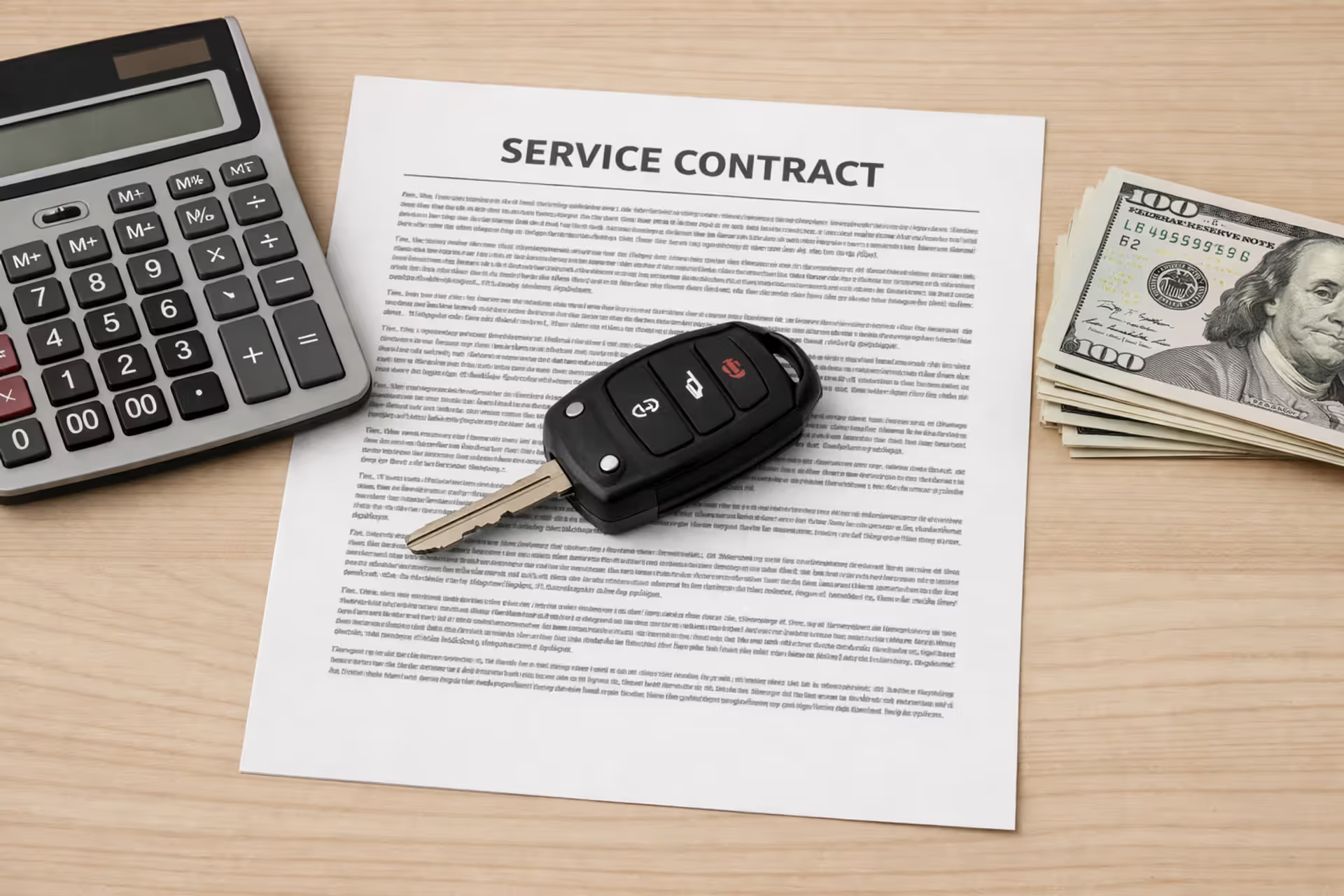
Calculator, car loan document, pen, toy car, and US dollar bills on a desk representing car payment calculation
Car Payment Formula: How to Calculate Your Monthly Auto Loan Payment

Content
Content
Understanding how lenders calculate your payment puts you on equal footing with the finance office. You'll catch inflated numbers in seconds, walk away from bad deals, and actually know whether dropping your rate by half a percent matters (spoiler: it absolutely does).
Breaking Down the Car Payment Formula
Every car loan in America gets calculated using this equation:
M = P
/Looks intimidating. It's not. Here's what each piece means:
- M = Monthly payment you're solving for
- P = Principal (the actual dollar amount you're borrowing)
- r = Monthly interest rate in decimal format
- n = How many monthly payments you'll make total
Let's work through a real scenario. You're financing $25,000. The dealer quoted you 6% APR. You picked the standard five-year term.
First step: convert that yearly rate into a monthly one. Take 6% and divide by 12 = 0.5% per month Convert 0.5% to decimal = 0.005
Your variables: - P = $25,000 - r = 0.005 - n = 60 payments (5 years × 12 months)
Plug everything in: M = 25,000
/Start with the exponent: (1.005)^60 = 1.34885
Multiply by your monthly rate: 0.005 × 1.34885 = 0.00674425
Then multiply by principal: 0.00674425 × 25,000 = 168.61
Work the denominator: 1.34885 - 1 = 0.34885
Final division: 168.61 ÷ 0.34885 = $483.32 monthly

Author: Brianna Lowell;
Source: shafer-motorsports.com
You'll pay exactly $483.32 for five straight years. What changes dramatically is where that money goes—early on, most fattens your lender's wallet. By year four, most actually reduces what you owe.
How Interest Rates Change Your Monthly Payment
Pull up a chair for this one. Same $25,000 car, same five-year term, four different rates:
| APR | Monthly Payment | Interest You'll Pay | Total Out-of-Pocket |
| 3% | $449.22 | $1,953.20 | $26,953.20 |
| 6% | $483.32 | $3,999.20 | $28,999.20 |
| 9% | $518.66 | $6,119.60 | $31,119.60 |
| 12% | $555.99 | $8,359.40 | $33,359.40 |
Between 3% and 6%, your monthly jumps just $34. Hardly noticeable when you're juggling rent and groceries. But check the middle column—you're handing the lender an extra two grand for absolutely nothing except a higher interest rate.
The 12% borrower versus the 3% borrower? That monthly difference climbs to $106.77. Over five years, the 12% person burns through $6,406.20 more in interest alone. That's a quarter of the car's original price evaporating into financing costs.
Even tiny rate drops add up fast. Shave one percentage point off a 6% loan—down to 5%—and you'll save around $15 monthly. Doesn't sound like much until you multiply across 60 months. That's $900 staying in your checking account instead of enriching your bank.
This is why rate shopping matters desperately. Three lenders might offer you 5.9%, 6.4%, and 7.1% on identical loan terms. Most people glance at the monthly difference—maybe $20 or $30—and shrug. Calculate total interest and that 5.9% lender saves you $1,500+ compared to accepting the 7.1% rate. Worth filling out two extra applications? Obviously.
The most important thing in finance is the interest rate. A small change in the rate can make a huge difference over the life of a loan — and most people never bother to do the math
— Warren Buffett
Loan Term Length: The 36 vs. 60 vs. 72 Month Trade-Off
Longer terms shrink your monthly obligation but bloat your total cost. Watch what happens to that $25,000 at 6%:
36-month loan: - Monthly payment: $761.65 - Total interest: $2,419.40 - Everything you'll pay: $27,419.40
60-month loan: - Monthly payment: $483.32 - Total interest: $3,999.20 - Everything you'll pay: $28,999.20
72-month loan: - Monthly payment: $414.32 - Total interest: $4,831.04 - Everything you'll pay: $29,831.04
That six-year payment feels gentle at $414.32—nearly $350 less than crushing yourself with a three-year term. But you're lighting $2,411.64 on fire compared to the aggressive payoff schedule.
Short loans hurt in the best way possible if your budget can handle them. You build equity lightning-fast. You're done making payments while your coworkers still have three years left. You own the title outright and can sell or trade whenever you want.
Here's where long loans destroy people: cars depreciate viciously. Expect 20% gone the second you leave the lot, another 15% annually for the next few years. Finance for six years and you'll owe more than the car's worth deep into year three, maybe year four. Wreck that car or need to sell during an emergency? Insurance cuts a check for market value, not your loan balance. You're writing a check for thousands just to get out of the loan.
Financial advisors I've talked to rarely recommend anything beyond 48 months. That four-year sweet spot keeps monthly payments reasonable without drowning you in interest or trapping you underwater for half the loan.
Author: Brianna Lowell;
Source: shafer-motorsports.com
What's Not in the Basic Formula: Hidden Costs That Affect Your Payment
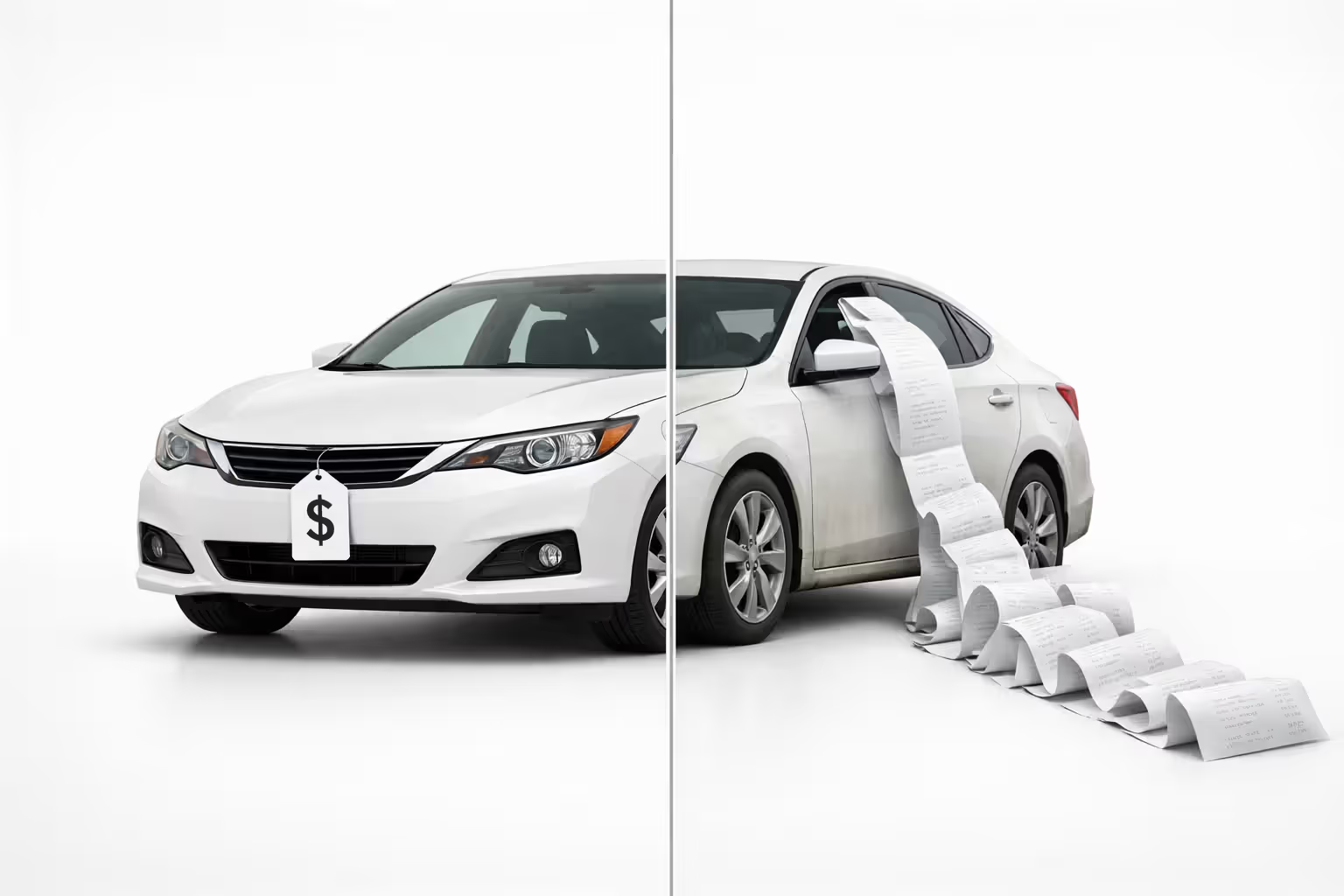
That formula only touches principal and interest. Dealers have an entire menu of extras they'll quietly fold into your financed amount.
Sales tax sneaks up on buyers hard. A $30,000 vehicle in a state charging 8% sales tax instantly adds $2,400. Dealers default to rolling it into your loan because it "keeps things simple." What they mean: you'll pay compound interest on a government tax for five years.
Registration, title, and doc fees swing anywhere from $200 to $500 depending on your state. These rarely appear as separate line items—they just materialize inside your total financed amount.
Gap insurance covers the difference if your car gets totaled while you're underwater. Dealers tack on $400 to $700 for this coverage, financed over your full loan term. Call your regular insurance agent and add gap for $20 to $40 yearly. Guess which option the finance manager steers you toward?
Extended warranties might inflate your loan by $1,500 to $3,000. The pitch sounds reasonable: "Only adds $47 monthly." You're paying interest on warranty coverage you'll probably never use, sold by a company whose business model depends on denying claims.
Dealer add-ons like paint protection, fabric treatments, nitrogen tire fills, or VIN etching pile on another $500 to $2,000. These deliver basically zero value but carry massive profit margins for the dealership.
Start shopping for a $25,000 vehicle and your actual financed amount might balloon past $30,000 once taxes, fees, warranties, and add-ons get included. Always calculate using your real financed number, not the advertised price.

Author: Brianna Lowell;
Source: shafer-motorsports.com
How to Build Your Own Car Payment Estimator
Two paths here: manual calculation to understand the mechanics, or spreadsheet template to run multiple scenarios quickly.
Manual calculation walkthrough:
- Convert annual rate to monthly decimal. Take 7.2% APR. Divide by 12 gets you 0.6% monthly. Shift decimal left twice: 0.006
- Calculate (1 + r) raised to the power of n. Financing 48 months at 0.006? (1.006)^48 = 1.32506. Most phone calculators have an exponent button.
- Multiply your result times the monthly rate: 1.32506 × 0.006 = 0.00795036
- Multiply by your loan amount: 0.00795036 × 28,000 = 222.61
- Take step 2's result minus 1: 1.32506 - 1 = 0.32506
- Divide step 4 by step 5: 222.61 ÷ 0.32506 = $684.85 monthly
Common mistakes that throw off your answer:
- Forgetting to divide APR by 12 (you need monthly rate, not annual)
- Using 6 instead of 0.06 (percentage versus decimal)
- Confusing years with months (four years means n = 48, not n = 4)
- Rounding too early—keep those extra decimals until the very end or you'll be several dollars off
Spreadsheet approach:
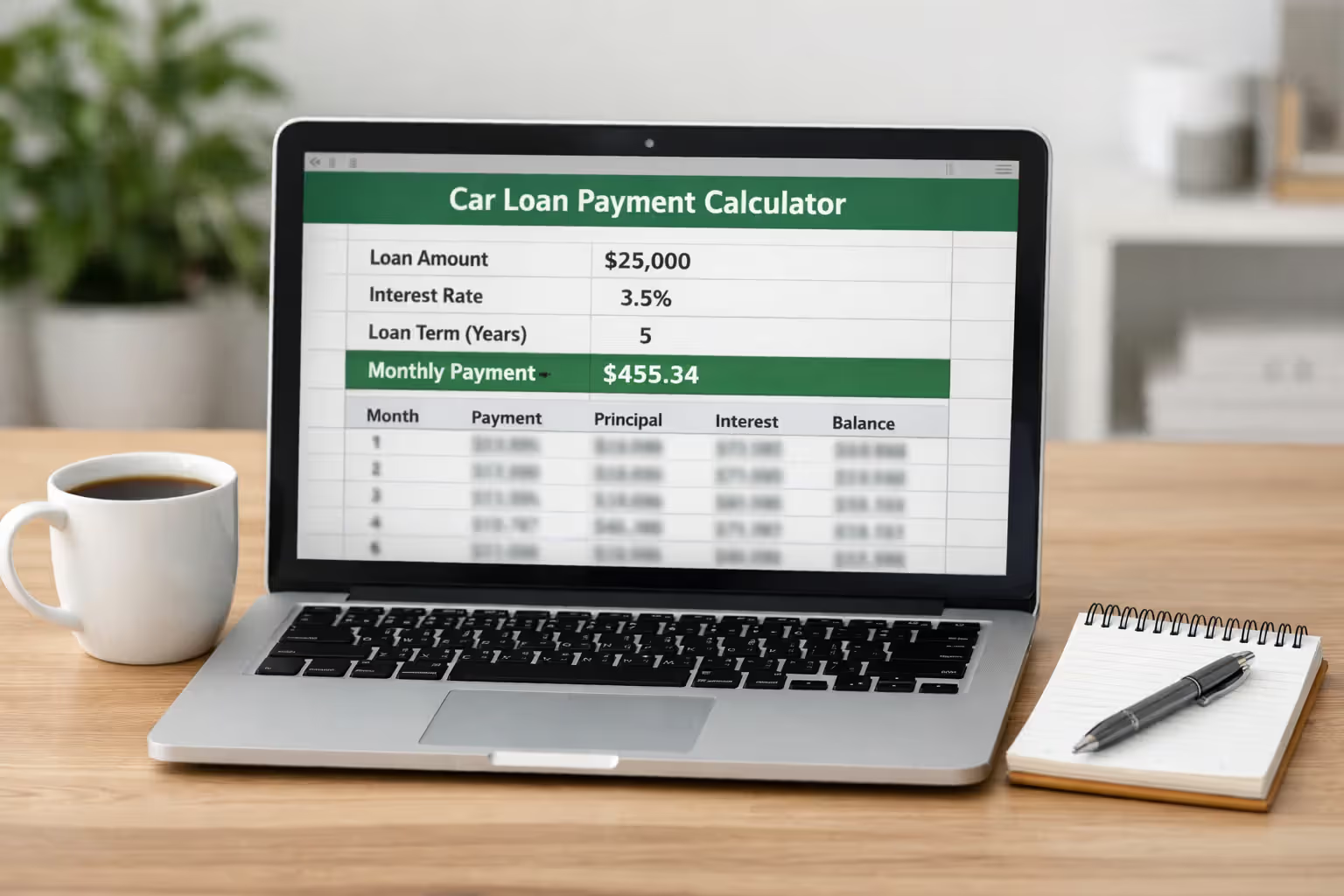
Excel and Google Sheets both use: =PMT(rate, nper, pv,
, )For that $28,000 at 7.2% over 48 months: =PMT(7.2%/12, 48, -28000)
That negative sign matters—tells the software money flows to you initially, so payments flow away. Result: $684.85.
Save this spreadsheet. Change loan amount, rate, or term in seconds to test different scenarios.
Author: Brianna Lowell;
Source: shafer-motorsports.com
Understanding Your Amortization Schedule
Your payment stays constant, but how it splits between reducing your debt and enriching your lender shifts dramatically every single month.
Here's year one on that $25,000 loan at 6% over 60 months:
| Payment Number | Payment Amount | Applied to Principal | Interest Charge | What You Still Owe |
| 1 | $483.32 | $358.32 | $125.00 | $24,641.68 |
| 2 | $483.32 | $359.90 | $123.42 | $24,281.78 |
| 3 | $483.32 | $361.49 | $121.83 | $23,920.29 |
| 4 | $483.32 | $363.09 | $120.23 | $23,557.20 |
| 5 | $483.32 | $364.71 | $118.61 | $23,192.49 |
| 6 | $483.32 | $366.33 | $116.99 | $22,826.16 |
| 7 | $483.32 | $367.96 | $115.36 | $22,458.20 |
| 8 | $483.32 | $369.60 | $113.72 | $22,088.60 |
| 9 | $483.32 | $371.25 | $112.07 | $21,717.35 |
| 10 | $483.32 | $372.91 | $110.41 | $21,344.44 |
| 11 | $483.32 | $374.58 | $108.74 | $20,969.86 |
| 12 | $483.32 | $376.26 | $107.06 | $20,593.60 |
First payment breaks down as $358.32 toward your car, $125.00 toward the bank's profit. By payment twelve, you're sending $376.26 toward principal with only $107.06 going to interest. This rebalancing continues throughout your entire loan.
The math: multiply your remaining balance by monthly rate to find that month's interest. Month one: $25,000 × 0.005 = $125.00 in interest. Subtract from your $483.32 payment leaves $358.32 attacking the principal.
Month two starts with $24,641.68 outstanding. Interest drops to $123.42. More of your identical payment now chips away at what you borrowed.
This structure makes early extra payments incredibly powerful. Throw $100 extra at principal during month one? You just eliminated $100 that would've collected interest for 59 more months. Toss that same $100 toward principal in month 59? You save exactly one month's interest.
Even small additional principal payments early in your loan can shave months off your payoff and save hundreds in interest. Just confirm with your lender that extra payments hit principal directly—some banks try to apply them as prepayment of future scheduled payments instead, which defeats the entire purpose.
Rather than borrowing to afford more car, borrow less and pay it off faster. The freedom of owning your vehicle outright is worth far more than any upgrade
— Dave Ramsey
Frequently Asked Questions About Car Payment Calculations
Taking Control of Your Car Financing
This isn't academic theory—it's your negotiating leverage. Walk into any dealership armed with payment calculations across multiple scenarios and suddenly you're not dependent on whatever their computer screen shows. You'll recognize when that "super low monthly payment" actually costs three grand in unnecessary interest. You'll spot when fees and add-ons have inflated your financed amount by 20%.
Calculate various down payment amounts before shopping. You'll see exactly how much each extra $1,000 upfront saves monthly and across the loan's lifetime. Stack 48-month and 60-month terms side-by-side with actual numbers. Decide whether that smaller payment justifies additional interest based on your real budget, not the salesperson's suggestion.
Collect offers from three or four lenders before visiting dealerships. A 5.9% quote from your credit union versus 7.2% from dealer financing sounds like minor variance until you calculate total interest difference—often $1,500 or more. That 30-minute credit union application suddenly becomes incredibly valuable.
Most importantly, run all calculations before stepping into a showroom. Know your comfortable payment range based on the vehicle's real price, not whatever monthly figure a salesperson thinks "works for your budget." This flips the entire dynamic from "What payment fits your budget?" to "Here's my offer based on actual mathematics."
Master this formula and you control the conversation. Buyers who understand the underlying math don't get blindsided by contract terms and don't overpay for financing they'll be stuck with for years.
Expert Perspective:
"I've watched countless buyers fixate exclusively on monthly payment while ignoring everything else, which plays perfectly into dealership strategy. Someone walks in, celebrates paying $50 less monthly, and completely misses that they just extended from 60 to 72 months and will now pay $2,000 extra in interest. Once you actually understand what drives that payment—principal, rate, and term—you optimize for total cost instead of just what feels manageable today. That perspective shift alone saves my clients thousands." — Michael Chen, Certified Financial Planner and author of "The Auto Finance Trap"
Related Stories

Read more
Read more


The content on Auto Insights is provided for general informational and educational purposes only. It is intended to offer guidance on car buying, vehicle ownership, finance, insurance, EVs, maintenance, accessories, reviews, and related topics, and should not be considered professional financial, legal, insurance, mechanical, or investment advice.
All information, tools, calculators, comparisons, and recommendations presented on this website are for general guidance only. Individual financial situations, driving habits, vehicle conditions, insurance policies, and market factors vary, and actual results or costs may differ from estimates provided.
Auto Insights makes no guarantees regarding accuracy, completeness, or current applicability of the information, as automotive markets, regulations, incentives, interest rates, and vehicle specifications may change over time.